ChatSyncs Help Center
DocumentationVideo TutorialsSupport Ticket
Developer APIREST endpoints for messages, contacts and templates.MCP serverConnect Claude, ChatGPT or Cursor to your account.
Sign inSupport sign-in
  • Docs
  • Videos
  • Tickets
  • For developers

    Developer APIREST endpoints for messages, contacts and templates.MCP serverConnect Claude, ChatGPT or Cursor to your account.
ChatSyncs Help Center

Guides, video lessons and support for ChatSyncs.

Help

  • Documentation
  • Video Tutorials
  • Search

Support

  • Get help
  • Your tickets
  • New ticket

Developers

  • MCP ↗
  • Developer API ↗

ChatSyncs

  • Open ChatSyncs ↗
  • Website ↗

© 2026 ChatSyncs

  • Overview
    • What Is Meta — and Why Do You Need a Facebook Account for WhatsApp?
    • What Is the WhatsApp Cloud API?
    • What Is a Meta Business Portfolio? (vs. Business Manager)
    • What Is a Meta Developer Account — and What Is an 'App'?
    • What Is a WABA (WhatsApp Business Account)?
    • Which WhatsApp Connection Method Is Right for You with ChatSyncs?
    • How to Connect Your WhatsApp Business App to ChatSyncs
    • What Is a BSP — and Can You Move to ChatSyncs From One?
    • Business Verification, Display Name, Green Tick — What's the Difference?
    • WhatsApp Business API Explained (And the Verification Myth)
    • Who Charges You for WhatsApp — Meta or ChatSyncs?
    • What WhatsApp API Pricing Really Means
    • WhatsApp Rules: How to Never Get Banned
  • Setup and Configuration
    • How to Connect Your Number to ChatSyncs
    • How to Connect Your WhatsApp Business App to ChatSyncs
    • How to Create a Facebook Business Manager Account for ChatSyncs
    • Set Up Your Meta Business Account for WhatsApp
    • How to Connect Your WhatsApp Account Manually (Alternative Method) in ChatSyncs
    • How to Add Payment Method for WhatsApp API Billing
    • How to Update Your WhatsApp Business Profile
    • How to Migrate from WhatsApp App to a ChatSyncs Business Account
    • How to Disconnect Another Partner From Your WhatsApp Number
    • How to Reconnect Your Disconnected ChatSyncs Account
    • How to Delete Your Phone Number on Meta
    • Transactions in ChatSyncs
  • Bot Settings
    • How Do I Configure General Bot Behavior with ChatSyncs?
    • How Do I Turn On Webhook Triggers for My Bot with ChatSyncs?
    • How Do I Set Up Business Hours for My Bot with ChatSyncs?
    • How Do I Configure Shared Inbox Settings for My Bot with ChatSyncs?
    • How Do I Automatically Add Subscribers to My Email Marketing List with ChatSyncs?
    • How Do I Save Subscriber Details to Google from My Bot with ChatSyncs?
    • How Do I Send an Automatic Email from My Bot with ChatSyncs?
    • How Do I Send an Automatic SMS from My Bot with ChatSyncs?
  • Subscriber Manager
    • What Is Subscriber Manager in ChatSyncs?
    • How Do I Manage Custom Fields, Labels, and Lists with ChatSyncs?
    • How Do I Import Subscribers Using a CSV File with ChatSyncs?
    • How Do I Add a Subscriber Manually with ChatSyncs?
    • How Do I Import Subscribers from Google Sheets with ChatSyncs?
    • How to Import Contacts from Google Contacts in ChatSyncs
  • Automation
    • How to Create a Keyword-Based WhatsApp Chatbot in ChatSyncs
    • How to Set Up Quick Actions (No Match, Get Started, and More) in ChatSyncs
    • How to Make a Chatbot Reply to Any Keyword in ChatSyncs
    • User Input Flow in ChatSyncs
    • WhatsApp Flow Forms in ChatSyncs
    • How to Connect a Bot Flow to External Systems in ChatSyncs
    • How to Build Automatic Follow-Up Chatbots on WhatsApp in ChatSyncs
    • How to Set Up Sales Sequence Chatbots in ChatSyncs
    • How to Add Clickable CTA Buttons in ChatSyncs
    • Audio Message in ChatSyncs
    • How to Add a WhatsApp Chat Widget to Your Website in ChatSyncs
    • How to Use User Input Flow in the Chat Widget in ChatSyncs
    • How to Add ChatSyncs Chat Widget to WordPress
  • Message Templates
    • Creating a WhatsApp Message Template in ChatSyncs
    • Why Templates Get Rejected and How to Fix Them in ChatSyncs
    • Character Limits for Media Message Templates in ChatSyncs
    • Guidelines for Utility and Marketing Templates in ChatSyncs
    • Understanding Conversations and Their Types in ChatSyncs
    • How to Create and Use Carousel Media Templates in ChatSyncs
    • Create Templates in WhatsApp Manager and Sync to ChatSyncs
    • Template Variables vs Custom Variables — What's the Difference with ChatSyncs?
    • Templates to Restart Conversations After Non-Working Hours in ChatSyncs
    • Understanding WhatsApp Quality Rating in ChatSyncs
  • Broadcasting
    • Send a Bulk Message to Many People
  • Shared Inbox
    • Introduction to Shared Inbox in ChatSyncs
    • Filter Conversations by Channel & Account in ChatSyncs
    • Organize Conversations with Labels, Views & Search in ChatSyncs
    • AI Translation & Message Rewrite in ChatSyncs
    • Team Collaboration & Agent Assignment in ChatSyncs
    • Messaging Tools: Canned Responses, Templates & Attachments in ChatSyncs
    • Follow-up Reminders & Message Sequences in ChatSyncs
    • Managing Customer Data with Custom Fields in ChatSyncs
    • Settings Menu: Groupchat Widget, Dark Mode, Follow-up List & More in ChatSyncs
    • Install ChatSyncs on Android
    • Install ChatSyncs on iOS
  • Webhooks
    • Webhook for Messages & Status Changes in ChatSyncs
    • Webhook on Keyword Trigger in ChatSyncs
    • Webhook on Button Click in ChatSyncs
    • Webhook for Input Flow in ChatSyncs
    • Webhook for WhatsApp Flows in ChatSyncs
  • Webhook Workflow
    • Create a Webhook Workflow in ChatSyncs
    • Webhook Automation Settings in ChatSyncs
    • Webhook Workflow Reporting in ChatSyncs
  • Integrations
    • How to Integrate Shopify for WhatsApp Automation in ChatSyncs
    • How to Connect Google to ChatSyncs
    • Google Sheet Fetch in ChatSyncs
    • How to Send Automated WhatsApp Messages on WP Form Submission in ChatSyncs
    • How to Set Up SMS Marketing in ChatSyncs
    • HTTP API Integration in ChatSyncs
    • Email Integration in ChatSyncs
    • How Do I Connect an SMTP Email Provider with ChatSyncs?
    • How Do I Connect Mailgun for Sending Email with ChatSyncs?
    • How Do I Connect Postmark for Transactional Email with ChatSyncs?
    • SMS Integration in ChatSyncs
    • How Do I Connect Twilio for SMS with ChatSyncs?
    • How Do I Connect Africa's Talking for SMS with ChatSyncs?
    • How Do I Connect a Custom SMS Gateway via HTTP GET with ChatSyncs?
    • Auto Responder Integration in ChatSyncs
    • How Do I Connect Brevo for Auto Responder with ChatSyncs?
    • How Do I Connect Mailchimp for Auto Responder with ChatSyncs?
    • How Do I Connect ActiveCampaign for Auto Responder with ChatSyncs?
    • How Do I Connect Mautic for Auto Responder with ChatSyncs?
  • AI Agents
    • How to Create Your First AI Agent in ChatSyncs
    • How to Train Your AI Chatbot in ChatSyncs
    • Agent Routing in ChatSyncs
    • AI Agent Actions in ChatSyncs
    • How Do I Restrict AI on Specific Keywords with ChatSyncs?
    • How Do I Auto-Assign Conversations to a Department with ChatSyncs?
    • How Do I Build a Multi-Agent AI Workforce with ChatSyncs?
  • Team Management
    • Introduction to Team Management in ChatSyncs
    • How to Add and Manage Team Members in ChatSyncs
    • How to Set Up User Roles and Permissions in ChatSyncs
    • Security in ChatSyncs
  • Account Safety
    • WhatsApp Account Bans: Causes and How to Stay Protected in ChatSyncs
    • How to Appeal a WhatsApp Business API Ban and Get Your Number Back in ChatSyncs
MCP ↗Developer API ↗
Browse guides
  • Overview
    • What Is Meta — and Why Do You Need a Facebook Account for WhatsApp?
    • What Is the WhatsApp Cloud API?
    • What Is a Meta Business Portfolio? (vs. Business Manager)
    • What Is a Meta Developer Account — and What Is an 'App'?
    • What Is a WABA (WhatsApp Business Account)?
    • Which WhatsApp Connection Method Is Right for You with ChatSyncs?
    • How to Connect Your WhatsApp Business App to ChatSyncs
    • What Is a BSP — and Can You Move to ChatSyncs From One?
    • Business Verification, Display Name, Green Tick — What's the Difference?
    • WhatsApp Business API Explained (And the Verification Myth)
    • Who Charges You for WhatsApp — Meta or ChatSyncs?
    • What WhatsApp API Pricing Really Means
    • WhatsApp Rules: How to Never Get Banned
  • Setup and Configuration
    • How to Connect Your Number to ChatSyncs
    • How to Connect Your WhatsApp Business App to ChatSyncs
    • How to Create a Facebook Business Manager Account for ChatSyncs
    • Set Up Your Meta Business Account for WhatsApp
    • How to Connect Your WhatsApp Account Manually (Alternative Method) in ChatSyncs
    • How to Add Payment Method for WhatsApp API Billing
    • How to Update Your WhatsApp Business Profile
    • How to Migrate from WhatsApp App to a ChatSyncs Business Account
    • How to Disconnect Another Partner From Your WhatsApp Number
    • How to Reconnect Your Disconnected ChatSyncs Account
    • How to Delete Your Phone Number on Meta
    • Transactions in ChatSyncs
  • Bot Settings
    • How Do I Configure General Bot Behavior with ChatSyncs?
    • How Do I Turn On Webhook Triggers for My Bot with ChatSyncs?
    • How Do I Set Up Business Hours for My Bot with ChatSyncs?
    • How Do I Configure Shared Inbox Settings for My Bot with ChatSyncs?
    • How Do I Automatically Add Subscribers to My Email Marketing List with ChatSyncs?
    • How Do I Save Subscriber Details to Google from My Bot with ChatSyncs?
    • How Do I Send an Automatic Email from My Bot with ChatSyncs?
    • How Do I Send an Automatic SMS from My Bot with ChatSyncs?
  • Subscriber Manager
    • What Is Subscriber Manager in ChatSyncs?
    • How Do I Manage Custom Fields, Labels, and Lists with ChatSyncs?
    • How Do I Import Subscribers Using a CSV File with ChatSyncs?
    • How Do I Add a Subscriber Manually with ChatSyncs?
    • How Do I Import Subscribers from Google Sheets with ChatSyncs?
    • How to Import Contacts from Google Contacts in ChatSyncs
  • Automation
    • How to Create a Keyword-Based WhatsApp Chatbot in ChatSyncs
    • How to Set Up Quick Actions (No Match, Get Started, and More) in ChatSyncs
    • How to Make a Chatbot Reply to Any Keyword in ChatSyncs
    • User Input Flow in ChatSyncs
    • WhatsApp Flow Forms in ChatSyncs
    • How to Connect a Bot Flow to External Systems in ChatSyncs
    • How to Build Automatic Follow-Up Chatbots on WhatsApp in ChatSyncs
    • How to Set Up Sales Sequence Chatbots in ChatSyncs
    • How to Add Clickable CTA Buttons in ChatSyncs
    • Audio Message in ChatSyncs
    • How to Add a WhatsApp Chat Widget to Your Website in ChatSyncs
    • How to Use User Input Flow in the Chat Widget in ChatSyncs
    • How to Add ChatSyncs Chat Widget to WordPress
  • Message Templates
    • Creating a WhatsApp Message Template in ChatSyncs
    • Why Templates Get Rejected and How to Fix Them in ChatSyncs
    • Character Limits for Media Message Templates in ChatSyncs
    • Guidelines for Utility and Marketing Templates in ChatSyncs
    • Understanding Conversations and Their Types in ChatSyncs
    • How to Create and Use Carousel Media Templates in ChatSyncs
    • Create Templates in WhatsApp Manager and Sync to ChatSyncs
    • Template Variables vs Custom Variables — What's the Difference with ChatSyncs?
    • Templates to Restart Conversations After Non-Working Hours in ChatSyncs
    • Understanding WhatsApp Quality Rating in ChatSyncs
  • Broadcasting
    • Send a Bulk Message to Many People
  • Shared Inbox
    • Introduction to Shared Inbox in ChatSyncs
    • Filter Conversations by Channel & Account in ChatSyncs
    • Organize Conversations with Labels, Views & Search in ChatSyncs
    • AI Translation & Message Rewrite in ChatSyncs
    • Team Collaboration & Agent Assignment in ChatSyncs
    • Messaging Tools: Canned Responses, Templates & Attachments in ChatSyncs
    • Follow-up Reminders & Message Sequences in ChatSyncs
    • Managing Customer Data with Custom Fields in ChatSyncs
    • Settings Menu: Groupchat Widget, Dark Mode, Follow-up List & More in ChatSyncs
    • Install ChatSyncs on Android
    • Install ChatSyncs on iOS
  • Webhooks
    • Webhook for Messages & Status Changes in ChatSyncs
    • Webhook on Keyword Trigger in ChatSyncs
    • Webhook on Button Click in ChatSyncs
    • Webhook for Input Flow in ChatSyncs
    • Webhook for WhatsApp Flows in ChatSyncs
  • Webhook Workflow
    • Create a Webhook Workflow in ChatSyncs
    • Webhook Automation Settings in ChatSyncs
    • Webhook Workflow Reporting in ChatSyncs
  • Integrations
    • How to Integrate Shopify for WhatsApp Automation in ChatSyncs
    • How to Connect Google to ChatSyncs
    • Google Sheet Fetch in ChatSyncs
    • How to Send Automated WhatsApp Messages on WP Form Submission in ChatSyncs
    • How to Set Up SMS Marketing in ChatSyncs
    • HTTP API Integration in ChatSyncs
    • Email Integration in ChatSyncs
    • How Do I Connect an SMTP Email Provider with ChatSyncs?
    • How Do I Connect Mailgun for Sending Email with ChatSyncs?
    • How Do I Connect Postmark for Transactional Email with ChatSyncs?
    • SMS Integration in ChatSyncs
    • How Do I Connect Twilio for SMS with ChatSyncs?
    • How Do I Connect Africa's Talking for SMS with ChatSyncs?
    • How Do I Connect a Custom SMS Gateway via HTTP GET with ChatSyncs?
    • Auto Responder Integration in ChatSyncs
    • How Do I Connect Brevo for Auto Responder with ChatSyncs?
    • How Do I Connect Mailchimp for Auto Responder with ChatSyncs?
    • How Do I Connect ActiveCampaign for Auto Responder with ChatSyncs?
    • How Do I Connect Mautic for Auto Responder with ChatSyncs?
  • AI Agents
    • How to Create Your First AI Agent in ChatSyncs
    • How to Train Your AI Chatbot in ChatSyncs
    • Agent Routing in ChatSyncs
    • AI Agent Actions in ChatSyncs
    • How Do I Restrict AI on Specific Keywords with ChatSyncs?
    • How Do I Auto-Assign Conversations to a Department with ChatSyncs?
    • How Do I Build a Multi-Agent AI Workforce with ChatSyncs?
  • Team Management
    • Introduction to Team Management in ChatSyncs
    • How to Add and Manage Team Members in ChatSyncs
    • How to Set Up User Roles and Permissions in ChatSyncs
    • Security in ChatSyncs
  • Account Safety
    • WhatsApp Account Bans: Causes and How to Stay Protected in ChatSyncs
    • How to Appeal a WhatsApp Business API Ban and Get Your Number Back in ChatSyncs
MCP ↗Developer API ↗
DocumentationAI Agents

How to Train Your AI Chatbot in ChatSyncs

How to attach Knowledge Sources — Content, URL, File, Media, Google Sheet, or HTTP API — to an AI agent so its replies stay accurate to your business.

On this page
  • Content
  • URL
  • File
  • Media
  • Google Sheet
  • API
  • Google account permissions this needs
  • Use cases
  • Frequently asked
  • Learn From a Use Case

An AI agent with no training data has nothing to answer from beyond its System Prompt. Knowledge Sources are how you give it real business content — FAQs, product information, internal docs — so its replies stay accurate to your business instead of sounding generic. This is configured directly on the agent, as part of creating or editing it.

Knowledge Sources panel on the Create AI Agent form, with a Knowledge Set dropdown (Select Existing or Create New) and six source type buttons — Content, URL, File, Media, Google Sheet, and API — plus an Attached Knowledge list showing No sources yet
  1. 1

    Pick or create a Knowledge Set

    Under Knowledge Sources on the agent's form, open Knowledge Set and either select an existing one or create a new one. A Knowledge Set is the container multiple pieces of content get added into.

  2. 2

    Add content from one or more types

    Click a type button to add content into the Knowledge Set: Content, URL, File, Media, Google Sheet, or API. Unlike an agent's System Prompt, a Knowledge Set can hold multiple sources together — the agent uses all of them to answer.

  3. 3

    Check Attached Knowledge

    Everything you've added shows up in the Attached Knowledge list on the same panel, with a count next to the section title.

Content#

Content panel with a single text box: Write the content your agent should learn from...

The simplest source — just type or paste text the agent should learn from, then click Save.

Example:

text
We're open Monday to Saturday, 10 AM to 8 PM. We're closed on Sundays and public holidays.
Standard delivery takes 3-5 business days across India. Returns are accepted within 7 days of
delivery, as long as the product is unused and in its original packaging.

With this saved, a customer asking "Are you open on Sunday?" or "What's your return policy?" gets an answer pulled straight from this text — no need to write those replies yourself.

URL#

URL panel with a Campaign URL field, Fetch Content Configuration selectors, and Remove Content Configuration selectors, plus Generate Raw Response and Generate FAQ buttons

Paste in a page's URL — a pricing page, an FAQ page, an about page — and ChatSyncs reads its content for the agent to learn from.

Example: paste https://mystore.com/faq and the agent can now answer questions straight from that page, without you copying anything into ChatSyncs by hand.

The two optional sections below the URL field let you fine-tune exactly what gets read:

  • Fetch Content Configuration — only pull content from one specific part of the page, instead of the whole thing. Pick a Selector Type (ID or Class) and enter the Selector Name — the exact ID or class name from the page's HTML for the section you want.
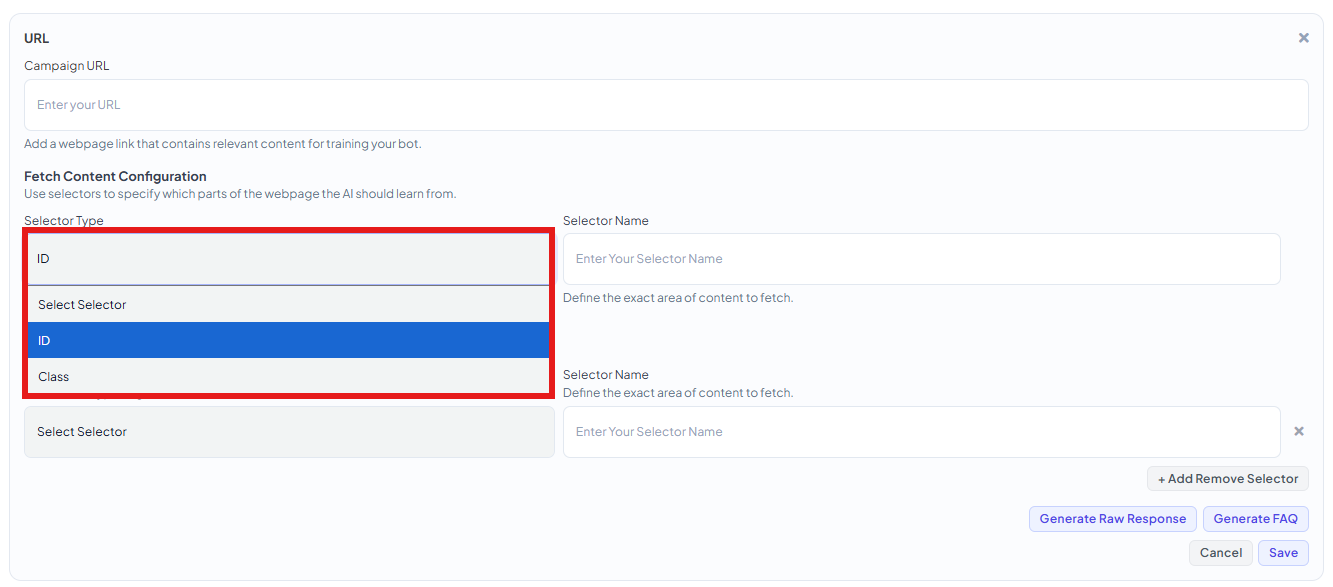
    Selector Type dropdown open showing ID and Class options
  • Remove Content Configuration — the opposite: exclude specific sections (like a header, footer, or navigation menu) that would otherwise clutter the training data. Click + Add Remove Selector to exclude more than one section.
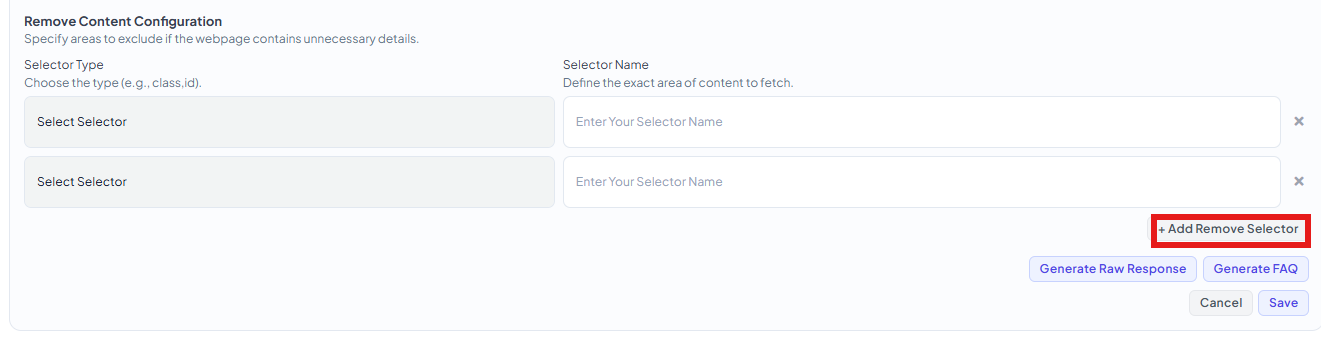
    Remove Content Configuration with two Selector Type / Selector Name rows and an Add Remove Selector button

Once the page is fetched, choose how it's stored:

  • Generate Raw Response — keeps it as one detailed block of content. More thorough, but uses more tokens per reply.
  • Generate FAQ — automatically breaks the page into short Question/Answer pairs instead. More efficient, since the agent only pulls in the exact pair it needs.

File#

File panel with an Upload button, and accepted formats listed: PDF, Word (.doc, .docx), Excel (.xls, .xlsx), CSV, OpenDocument (.ods, .odt), TXT

Upload training manuals, product guides, or FAQs as PDF, Word (.doc/.docx), Excel (.xls/.xlsx), CSV, OpenDocument (.ods/.odt), or TXT. The same Generate Raw Response / Generate FAQ choice from URL applies here too, once the file is uploaded.

Media#

Media panel with an Image URL field, an Upload button, a Description field with placeholder text: e.g. Red cotton kurti, size M, price 1200 BDT, and an Add more image button

Add product photos or gallery images the agent can send when a customer asks for them. For each image, paste an Image URL (or click Upload) and write a short Description — this is what tells the agent when to send that photo, so be specific: name, and anything that distinguishes it (color, size, price).

Example:

text
Red cotton kurti, size M, price 1200 BDT

With this saved, a customer asking "Do you have this in red?" or "Show me the kurti" gets that exact photo sent back automatically. Click + Add more image to attach more than one.

Don't put image URLs directly in the System Prompt. Add them here, under Media, instead — the agent only sends a photo from Knowledge Sources when a customer's question matches its description.

Google Sheet#

Select a Sheet dropdown open, showing a connected Google account and its available sheets

Pick a sheet already connected — see How to Connect Google to ChatSyncs — the dropdown lists every sheet available to that account.

Google Sheet panel with a sheet selected under Import From Google Sheet, and a Save button

Example: picking a Customer Details sheet lets the agent answer questions using whatever that sheet contains — e.g. order history or account info — without you re-typing it anywhere.

API#

Add HTTP API panel with an HTTP API List dropdown

Pick one of your configured HTTP APIs — content is pulled dynamically from that endpoint's response rather than stored statically.

Google account permissions this needs#

If you plan to use Google Sheet as a training source, or want subscriber contacts synced alongside it, make sure the Google account connected via How to Connect Google to ChatSyncs granted both the Sheets and Contacts permissions during sign-in — granting only Sheets access leaves contact-dependent features without data.

Use cases#

  • Customer support — answer common questions the way a trained support agent would, in the business's own voice.
  • Product information — ground answers in the business's actual catalog or specs instead of generic AI guesses, with real product photos via Media.
  • Internal documentation — let staff-facing agents answer from internal wikis or SOPs.
  • Business FAQs — turn an existing FAQ page or document directly into training content.

Frequently asked#

How do I make an agent answer based on my own business info instead of generic answers?

Open the agent under Chatbot Manager → AI → Agents, go to its Knowledge Sources, pick or create a Knowledge Set, and add content — Content, URL, File, Media, Google Sheet, or API.

Can I combine a URL and a Google Sheet in the same Knowledge Set?

Yes — unlike the old single-source-per-campaign model, a Knowledge Set can hold multiple sources together, and the agent uses all of them to answer.

How do I get the agent to send a product photo?

Add it under Media in Knowledge Sources — not as a URL pasted into the System Prompt. The agent can then send it when a customer asks for photos.

My agent shows no useful answers — why?

Check that its Knowledge Set actually has content added — an empty Knowledge Set (or an agent with none selected) has nothing to answer from beyond its System Prompt.

  • An agent with no Knowledge Sources attached has nothing to answer from beyond its System Prompt.
  • Put images under Media, never as a URL in the System Prompt.

Learn From a Use Case#

  • Travel Assistant — stores the business's company info, destinations, pricing, and FAQs the AI Agent answers from.

Was this page helpful?

Still stuck? Open a support ticket and our team will help.

PreviousHow to Create Your First AI Agent in ChatSyncsNext Agent Routing in ChatSyncs

On this page

  • Content
  • URL
  • File
  • Media
  • Google Sheet
  • API
  • Google account permissions this needs
  • Use cases
  • Frequently asked
  • Learn From a Use Case